
Stop Buying 11-Inch Rubber Gloves (Class 00 or Class 0)
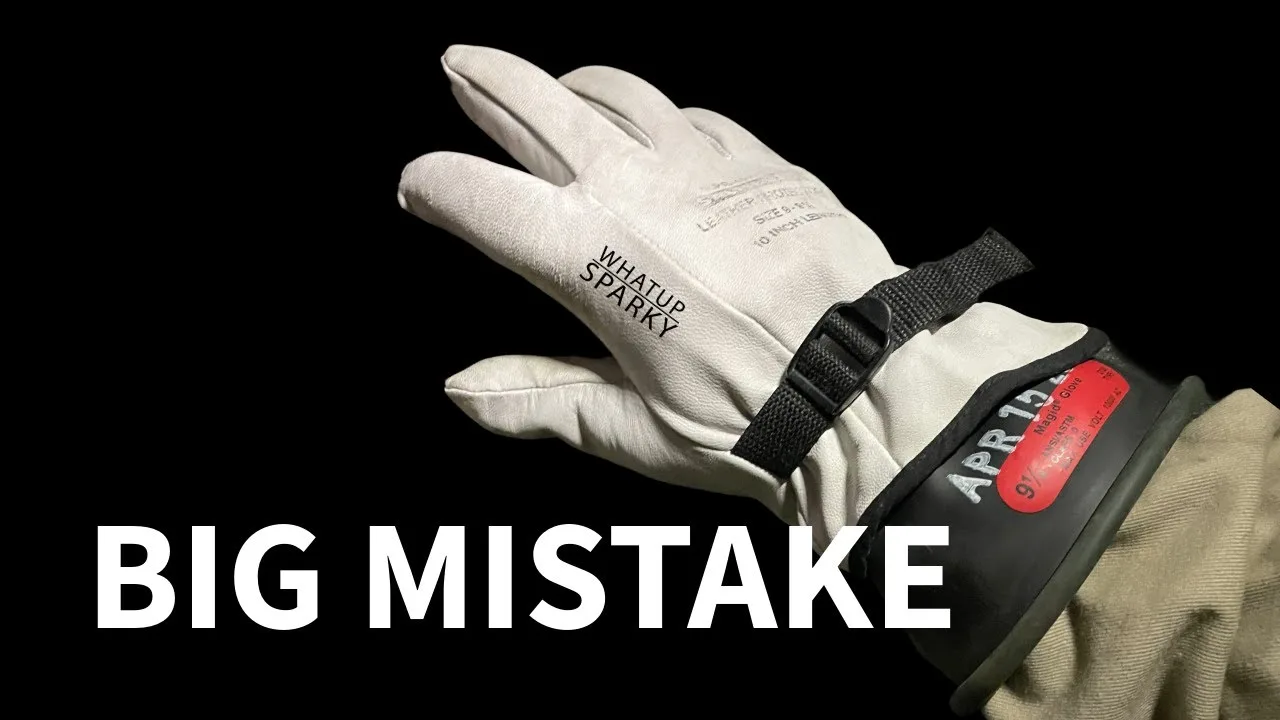
Go online right now and search for Class 0 rubber insulated gloves. I'd guess there's a 75 to 90 percent chance the first thing you'll find is an 11-inch glove. There's a huge problem with that. For a lot of the work we do, these gloves are too short.
Why we use Class 0 on 480
Much of my team's work is at 480 volts. Class 00 gloves are rated up to 500 volts AC. That's only a 20-volt buffer, and that doesn't sit well with me, even knowing the gloves are tested above their rating, let alone my team, who are not as familiar with the test standards. Occasionally we work on industrial equipment that should be 480 and it's over-volting above 500. So we just use Class 0, which is rated up to 1,000 volts AC, knowing that.
The 12-inch problem
If you need rubber insulated gloves working on 208 to 480 volt systems, you have a distance you're required to stay back from, even as a qualified person. NFPA 70E calls it the restricted approach boundary, and all unprotected parts of your body need to stay back from it. Here's how it lines up:
50 to 150 volts: avoid contact (no distance given)
151 to 750 volts: 12 inches
751 volts to 5 kV: 2 feet 1 inch (Class 0 tops out at 1,000 volts)
Those distances already include an adder for inadvertent movement.
So under 151 volts, both lengths and both classes are fine for direct contact. Over 151 volts, the boundary is 12 inches, which means an 11-inch glove is too short, Class 00 or Class 0. Put your hand on the energized part and your wrist and forearm are inside the boundary with no shock protection per code. If you buy 11-inch gloves, that means you can't even come within 1 inch of touching the energized part before your arm is breaking that boundary.
Where 11-inch gloves still work
The 11-inch glove has its place. It works when your hands are inside the boundary but not so close that your bare arms are exposed within the boundary, like taking a voltage reading with test probes. The tool reaches the part, not your hand.
It also works where the voltage is below 151 volts. There's no distance to break there, just avoid contact, so both lengths work for direct contact.
Another option: guarding
You can protect your arms by covering the energized parts around where you're working with rubber insulating blankets or voltage-rated plastic guards, so your arm has nothing exposed to touch. They have to be rated for the voltage, and blankets get tested every 12 months. Keep in mind that putting them on is its own task inside the boundary, so wear the right gloves for that part too.
Why are there so many 11-inch gloves?
Why are there so many 11-inch gloves out there, and why is it so hard to find a 14-inch glove? My guess is you go online, you type in rubber insulated gloves, and the one thing you know is the voltage. So you look for the cheapest glove, and the cheapest gloves are the 11-inch, if not just because they have less material. Now everyone's buying them, so demand is up, supply is heavy, and the price goes down. The 14-inch gloves, which are the ones you should have at a minimum, are kind of harder to find. They're not always in stock, and you kind of have to scroll down to get to them.
So the bigger problem is that a lot of people buy these gloves because they're easier to get, either not knowing what they're looking for, not knowing the requirements, and mainly not having a specification.
Have a spec
As part of your electrical safety program, you should have a simple one-sheeter that at bare minimum says:
The material
The class
The length
The next step would be a manufacturer and their certification level. If we're doing that right, we'll stop buying 11-inch gloves.
It's on you, too
It's on you as the electrician. If you're doing your risk assessment correctly and you say, hey, this is a 480-volt piece of equipment and I'm going to reach past something, maybe you're wrapping a CT around a conductor, right then and there you should ask yourself: is there any part of my body that's going to be exposed less than 12 inches from that source? If the answer is yes because you have 11-inch gloves, you should catch it.
Stop buying 11-inch gloves. Be safe out there.
This is general information, not a substitute for your employer's electrical safety program or task-specific training.
Watch the video
Written by Evan Banda "WhatUp Sparky"
CESCP, Energized Work Procedures-SME
WANT TO LEARN MORE ABOUT ELECTRICAL SAFETY?
Explore our full collection of articles on electrical safety, NFPA standards, and industry best practices.